
Local climate changes

Climate change is already having visible effects on the world. The earth is warming, rainfall patterns are changing, and sea levels are rising. These changes can increase the risk of heatwaves, floods, droughts, and fires. We know that greenhouse gases, aerosol emissions and land use affect our climate. Overall, human activity is warming our planet.

The global effects of climate change

Climate change can affect our climate system in lots of different ways: 

The level of climate change we will see depends on how quickly we cut emissions of dangerous greenhouse gases. Even if we were to stop all emissions today, we would not prevent some changes. However, the sooner we cut emissions, the smaller the changes will be. In a recent report, the Intergovernmental Panel on Climate Change (IPCC) showed the difference between 1.5°C and 2°C of global warming. But unless we reduce emissions rapidly, the world is likely to exceed 2°C of warming. By the end of this century, warming could potentially reach 4°C, possibly more.

If our climate continues to change, many parts of the world will become more challenging places to live. People may have to leave their homes. Climate is just one of many factors that influences human migration, but it will play an increasing role in the future.  
The effects of climate change are real, and they are already happening. Visit the Met Office website for more information.

Climate change and your local area

To some, warming weather may not seem like such a big deal. But even the smallest changes in climate can have far-reaching effects. Temperatures above 30°C for two or more days can trigger a public-health warning. In the 1990s, this happened about once every four years for locations in the South. By the 2070s, projections suggest it could be as frequently as four times per year - 16 times more often - if we do not curb our emissions.

Drought

During 2025 the South West has experienced periods of extended dry weather with high temperatures and limited rainfall. 'False autumn' is one effect of these prolonged dry periods. This is where trees prematurely change colour and shed leaves due to stress from drought or prolonged heatwaves. This current phenomenon can harm trees and disrupt wildlife habitats, making our ecosystems vulnerable to further damage including wildfires). You may see these effects occur more frequently on local trees in your community with the prolonged dry periods and little rain. This is an effect of climate change.

Flooding

Summer rain is likely to become less frequent but could be heavier when it does occur. Without regular rainfall, the ground has a harder time absorbing water when it finally does come, leading to a greater risk of flash flooding.
Floods will likely become a staple of warming winters as well. Steady rain, which is currently a feature of winter months, will probably continue, and total rainfall is expected to increase. When the ground is already saturated, waterways tend to rise. Bridges and sewers designed for historical rainfall levels may come increasingly under pressure. Warming temperatures could also mean cold spells become less frequent. Temperatures below freezing during the day and areas with considerable amounts of snow on the ground may be limited to parts of Scotland by the end of the century if emissions continue to rise.

Urban heat islands

Cheltenham, like other urban areas, may experience an enhanced urban heat island effect, where temperature are higher in the town than surrounding rural areas. This could be exacerbated by climate change, leading to more intense and localised heat waves during the summer months. 

Average temperature rise

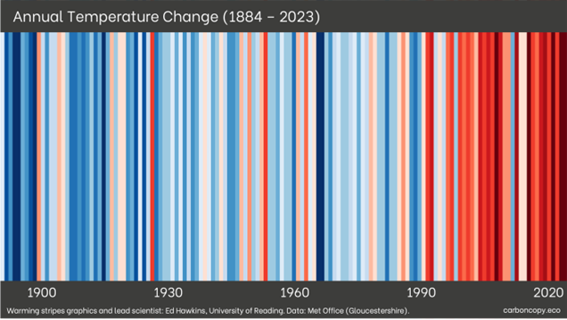
These warming stripes, created by Professor Ed Hawkins (University of Reading), show the temperature change in Cheltenham, from 1884 to 2023. Each stripe represents the average temperature for a single year, relative to the average temperature over the period as a whole. Shades of blue indicate cooler-than-average years, while red shows years that were hotter than average. The stark band of deep red stripes on the right-hand side of the graphic show the rapid heating in recent decades.

Warming stripes, created by Professor Ed Hawkins (University of Reading), show the temperature change in Cheltenham, from 1884 to 2023. Each stripe represents the average temperature for a single year, relative to the average temperature over the period as a whole. Shades of blue indicate cooler-than-average years, while red shows years that were hotter than average. A stark band of deep red stripes on the right-hand side of the graphic show the rapid heating in recent decades.

Visit the Met Office website for information on Cheltenham's average climate and weather.