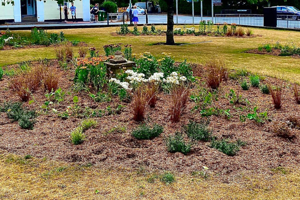
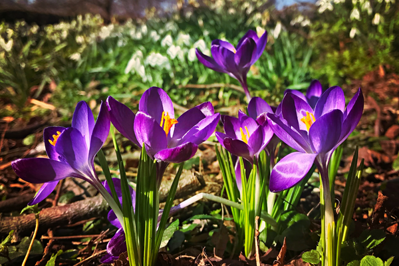
Habitat Cheltenham

Habitat Cheltenham was a biodiversity improvement project launched in 2018 to create a connected network of wildlife‑friendly habitats across Cheltenham town centre and enhance nature for people and local wildlife. With match-funding support from the European Regional Development Fund, £900,000 has been invested to improve habitat and biodiversity across 14 sites in Cheltenham.

ERDF logo HM Government logo

In order to make and measure these improvements, the project has focused on providing for pollinators, and in particular, solitary bee species. The Gloucestershire Wildlife Trust have assisted the project by monitoring these species and the improvements. Meadow creation, tree planting, community orchard creation, pocket parks, rain gardens, perennial planting and bulb planting are some of the improvements made.

Habitat Cheltenham is part of Cheltenham Borough Council’s commitment to:

View our interactive map highlighting the areas of focus for Habitat Cheltenham. The project is now completed with all sites having received biodiversity enhancement, creating improved habitat and connectivity across the town.


Improvements to the High Street

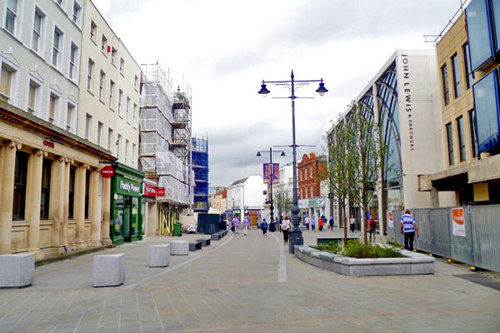
The aim of the project was to make the High Street a nicer place to be, which also benefited the local shops and businesses. It enabled the space to be used for events and made it difficult for vehicles to misuse the area. Almost £1 million had been invested in this area of the High Street, funded by Cheltenham Borough Council, Gloucestershire County Council and the European Regional Development Fund.


ERDF logo HM Government logo

Support for the project was provided by a number of partners including Gloucestershire County Council, Cheltenham BID (Business Improvement District) and Cheltenham Development Taskforce. The improvements were part of a bigger package of enhancements to the town centre which had already delivered benefits to the Lower High Street with the creation of pocket parks, cycle stands and the removal of railings after consultation with local businesses and residents. This is in addition to local transport improvements through the delivery of the Cheltenham Transport Plan. Work was completed on the first phase of improvements to the High Street from Rodney Road to Cambray Place. Shoppers and visitors were able to enjoy the new paving and seating, and new planters brought greenery to the heart of the high street. These planters were the first instalment of the Habitat Cheltenham project and have been filled with a variety of pollinator-friendly shrubs, perennials, bulbs and four semi-mature Bird Cherry (Prunus padus watereri) trees.

Before improvements
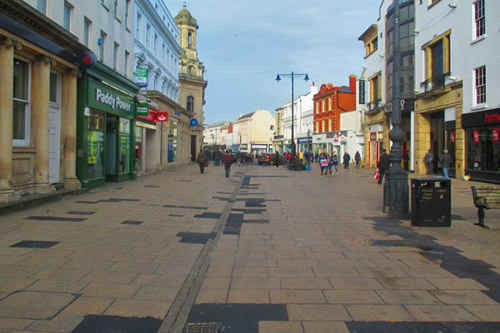
High Street before improvements

After improvements
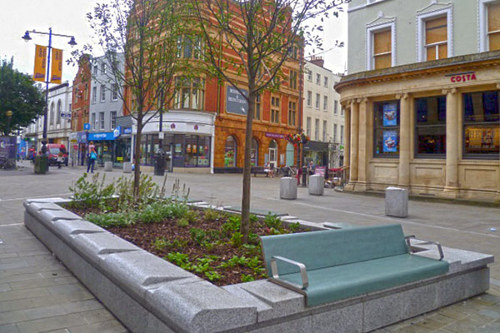
High Street after improvements

Planter installed as part of High Street improvements

Winston Churchill Memorial Garden project

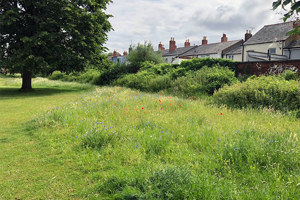
Winston Churchill Memorial Garden is a public park located at the end of the Lower High Street. It is a space of significant biodiversity value, due to its collection of mature trees and perennial scheme planted in 2018. There was an opportunity here to create habitats which would otherwise be more challenging to create in the centre of town, such as orchard and long grass/meadow creation.

With the help of European Regional Development Funding we were able to enhance biodiversity even more on this site as part of the Habitat Cheltenham project.

ERDF logo HM Government logo

In 2019 we engaged with stakeholders including Cheltenham West End Partnership and Friends of Winston Churchill Memorial Garden to agree how the funding could be used to increase biodiversity in the park. It was agreed that the southern entrance to Market Street should be the area of focus for biodiversity improvement.

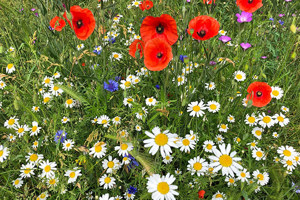
The proposed works included the creation of wildflower meadows with the support of Glorious Cotswold Grasslands-Cotswolds National Landscape who supplied a mix of locally harvested and local provenance perennial and annual native species, providing  a significant boost to supporting wildlife in the park and enhancing local biodiversity.

Wildflower meadow

In the first quarter of 2021 we were able to plant the community orchard with rare local, historical Gloucestershire varieties of fruit trees sourced with local provenance from the Gloucestershire Orchard Trust. The Trust, the leading charity dedicated to the conservation and celebration of traditional orchards in Gloucestershire, was instrumental in the selection of 17 apple, 12 plum and 7 pear trees. Fruit tree species are especially good at supporting a wide range of insect species, small mammals and birds and of course provide a colourful spring blossom.

Wildflower area in Winston Churchill memorial gardens Wildflowers

The council was also able to use existing railings to fashion a new gate, creating an access point for the volunteers when orchard maintenance is required. This gate is also accessible for a wheelchair and wheelbarrow.

More recently the park has seen the renovation of the two raised beds at the entrance to the High Street. With the help of volunteers, these beds have received new trees, shrubs and bulbs, bringing all year interest, increased habitat and improved biodiversity.

With the support of Gloucestershire Orchard Trust, the council’s townscape and green space development teams are pleased to have completed another stage of this fantastic project.


Get in touch

If you have any questions or comments, or would like to get involved in our projects, please email townscape@cheltenham.gov.uk

Stakeholders and partners

Stakeholders include: CBC trees department, CBC green space development, Cheltenham West End Partnership, Friends of Winston Churchill Memorial Garden and Honeybourne Line North, and ward councillors.

Perennial planting on Montpellier Roundabout

Montpellier roundabout was a part of the Habitat Cheltenham project, which aimed to create a network of biodiversity improvements across Cheltenham's town centre with matched funding support from the European Regional Development Fund.

ERDF logo HM Government logo

This roundabout was repeatedly planted over the years with the annual planting, which was very intensive in labour and maintenance. The Habitat Cheltenham project went from strength to strength thanks to Ubico and the green space development team. This perennial scheme was extremely cost-effective (reducing the maintenance visits, no more planting required, pruning once/twice a year, etc.) and had an amazing impact on biodiversity in this part of the town.

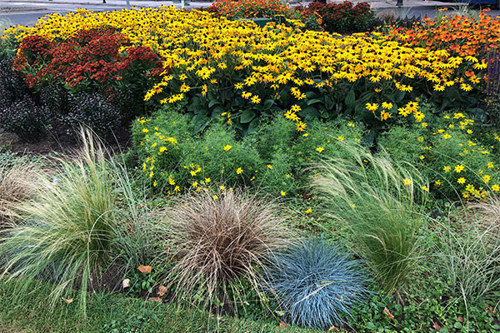
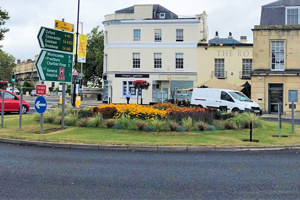
Variety of plants and shrubs on Montpellier roundabout

In order to make and measure these improvements, the project focused on providing for pollinators. Perennial species planted in June 2021 provided pollen, nectar, seeds and nesting material for birds and butterflies. Naturally, the greatest advantage that perennials have is that they come back year-after-year and hugely enhance one of the most important roundabouts in Cheltenham.

Within the 15 different species planted there is a selection of helleniums, rudbeickias, geraniums and a few different types of low growing grasses.

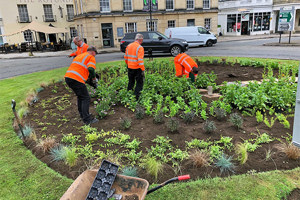
Ubico workers planting on Montpellier roundabout View of finished planting on Montpellier roundabout

The circular space left without plants was dedicated for the Christmas ornament returning on this spot every winter. 

If you have any questions or comments, or would like to get involved in our projects, please email townscape@cheltenham.gov.uk.

Minster Gardens

As part of the Minster Exchange (MX) scheme, the closed churchyard of Cheltenham Minster - the town’s oldest building - has benefitted from renovation and restoration works.

Now known as Minster Gardens, the project has received £229,000 of funding from the England European Regional Development Fund (ERDF).

ERDF logo HM Government logo

The investment has helped rejuvenate this historical conservation area and cultural core of the town centre. What was a dark and unwelcoming space has benefitted from a number of improvements, including the creation of more social space, additional paths and lighting across the gardens, and a range of seating so that everyone can enjoy the grounds of the Grade I Minster. Also included is an additional path with a seating area that links to the entrance of the new Minster Exchange (MX) building, which is in the final stages of construction, next to the gardens behind the Children’s Library.

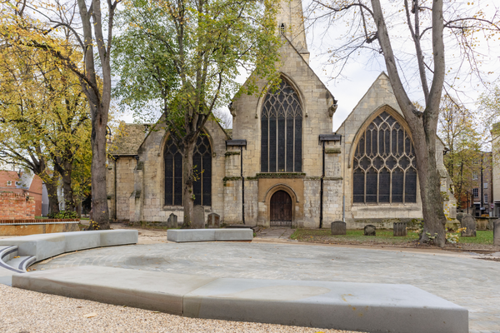
View of Cheltenham Minster showing new paving and seating installed as part of the Minster Gardens project

As part of the project, urgent and necessary conservation work on a number of historically significant memorials has been carried out, including the churchyard’s cross base (a scheduled ancient monument) and the Grade II Listed gate piers that mark the entrances to the Gardens. Numerous listed headstones and table tombs have also received conservation work, one of the best examples of which can be found nestling in the corner of the gardens, next to Cheltenham House. The Grade II listed ornate overthrow with integral light at the entrance to Famous alleyway has been brought back to its original glory, whilst several of the listed dragon and onion lamp posts have also received conservation attention.  Many locals are aware of the brass markers set within Processional Way and the project ensured that these were carefully lifted, cleaned and replaced exactly where they were found.

The mature lime trees that characterise the gardens have had their crowns lifted to allow more light to infiltrate the space and encourage ‘natural surveillance’ from the surrounding buildings, opening up the views across this beautiful area. Due to their poor condition, two trees required replacing and in their place two new cork oaks (Quercus suber) have been planted to diversify the species on site and to provide better resilience to climate change.

A dusk survey for bats identified common pipistrelle bats visiting the churchyard and roosting opportunities for local bats has been incorporated into the site through the installation of bat boxes. Existing lights has been modified and new lighting designed sensitively to create low-level lighting and minimise potential impacts on bats. Several bird boxes have also been introduced to encourage nesting birds.

The Gardens have also benefitted from an extensive planting scheme, with hundreds of bulbs having been planted, along with a variety of annual and perennial plants. A flowering meadow has been established on the west side of the Gardens, with a blend of ornamental, annual and perennial species, specifically selected to supply pollen bearing flowers to benefit bees, butterflies and other pollinating insects for the longest period possible, from spring through to early autumn.  The gabion-backed benches give small animals and insects the opportunity to take refuge and hibernate in winter and once fully established, the planting scheme will boost existing habitats and thus increase wildlife and biodiversity, whilst conserving the history of the site.

The Cheltenham Civic Society has helped establish a volunteer working group for the Minster Gardens.

Gloucestershire County Council logo

Gloucestershire County Council assisted the scheme by funding upgrades to existing paths and lighting.

Perennial planting in Berkeley Gardens

Due to match funding support from the European Regional Development Fund, Berkeley Gardens has been able to benefit from the council’s Habitat Cheltenham Project, which aimed to create a network of biodiversity improvements across Cheltenham's town centre.

ERDF logo HM Government logo

The beds in the garden were repeatedly planted over the years with annual planting, which was both labour and maintenance intensive.

All beds received an application of Fine Composted Bark to replenish poor soil conditions in preparation for perennial planting. An organic matter-rich soil conditioner, composted bark improves the soil structure, quality, organic matter levels and water holding capacity.

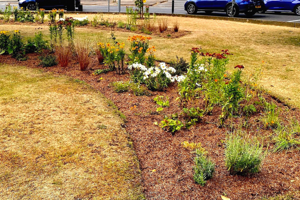
A variety of perennials and shrubs were planted, carefully selected to give a wide seasonal food-rich resource for pollinators and insects, introducing biodiversity and establishing mini-habitats supporting birds, insects and reptile species. Perennial species planted in July 2022 provide pollen, nectar, seeds and nesting material for birds and butterflies. Naturally, the greatest advantage that perennials have is that they come back year-after-year to enhance one of the most important gardens in Cheltenham.


Within the 16 different species planted there is a selection of helleniums, rudbeickias, geraniums, lavenders and different types of grasses. A tall mix of tulip species were inter-planted, to provide more visual interest and an early food source for pollinators.

We've used Strulch to mulch the beds as it is a light and easy to use garden mulch made from wheat straw for organic gardening. 

Strulch has a neutral pH, reduces weed growth, helps retain moisture around plants, enriches soil and its structure, is suitable around flowers, shrubs, fruit and vegetables and lasts up to two years, spreading the cost, saving water and fertiliser, making the plants grow healthier and stronger. ​The physical properties of this mulch together with the embedded minerals deters slugs and snails.

If you have any questions or comments, or would like to get involved in our projects, please email townscape@cheltenham.gov.uk.

Bulb planting across the town centre

As part of secured match funding from the European Regional Development Fund, the council has delivered bulb planting across the town. This has been achieved by partnering with the council’s climate change team and other partners to improve the quality of habitat across a number of sites in Cheltenham.

ERDF logo HM Government logo

The planting of bulbs supports increased biodiversity by improving grass habitat and food sources for insects and pollinators. Changes to maintenance regimes, with reduced mowing, support the creation of wildlife corridors.

The works brought about a number of environmental benefits including:
  • Habitat creation
  • Increased biodiversity
  • Reduced flood risk
  • Improvements to water quality
  • Increasing target species
  • Engaging communities with the outdoors
  • Improving urban air quality
  • An improved, interconnected network of habitats
  • Enhancing sites as valuable public green space with enhanced biodiversity
  • Increasing amenity value of sites and ultimately well-being

Bulb planting locations

  • Honeybourne Line/High Street halt
  • Millbrook roundabout
  • Honeybourne Way roundabout
  • Royal Well
  • High Street refresh planters
  • Berkeley Gardens
  • Willoughby triangle
  • Cheltenham Walk
  • Honeybourne Gateway
  • Front entrance to Winston Churchill Memorial Garden

Get in touch

If you have any questions or comments, or would like to get involved in our projects, please email townscape@cheltenham.gov.uk

Stakeholders and partners

Stakeholders include: ERDF, HM Government, CBC trees department, Ubico.

Greening our car parking areas

High Street car park and St George's Road car park are public car parks located in Cheltenham town centre. Both locations, due to the nature of their use, were lacking in biodiversity value. There was an opportunity here to create habitats which might not otherwise establish in this environment and help connect existing habitats. By creating areas of evergreen vegetation and by planting trees in the middle of the sites, the impact of planting intervention will increase connectivity for insects and small invertebrates.

We secured European Regional Development Fund to improve biodiversity across the town centre as part of the Habitat Cheltenham project.

ERDF logo HM Government

High Street car park

Planting has been added along the entrance to the car park.

Planting at entrance to High Street car park Entrance to High Street car park showing plants at the edge

With new trees added to the car park, we worked closely with the contractor to design a “hand-made” bespoke tree protector.

We came up with the idea of replacing the tree guards, which weren’t strong enough to protect our car park trees, by repurposing these lamp-post protectors, which are now solidly installed and robust. The existing grilles have been cut to accommodate the new tree protectors and welded together for increased strength.

Light-coloured, permeable gravel will reflect the sunlight during sunny periods, keeping the tree pits moist and hopefully litter free. It also acts as a compacted underlay for the grilles (if a vehicle drives on to the grille, the gravel will stop the grille from bending down and breaking).

Tree in High Street car park with tree guard

St George's Road car park

Planting along front edge of St George's Road car park Small plants along the wall of St George's Road car park


Get in touch

If you have any questions or comments, or would like to get involved in our projects, please email townscape@cheltenham.gov.uk

Stakeholders and partners

Stakeholders include: ERDF, HM Government, CBC trees department, Ubico.

This project was also running in parallel with the green space development team’s urban greening project.

If you have any questions or comments please email townscape@cheltenham.gov.uk

Gloucestershire County Council logo
Gloucestershire Wildlife Trust logo